

Your stack is the 9.4-app bottleneck.
The cost of your stack isn't the subscriptions. It's the four seconds you lose every time you switch apps, twelve hundred times a day.

9.4. That’s how many different applications the average knowledge worker opens in a single day, according to the productivity research now widely cited across SaaS consolidation reports.
Not in a week. In a day.
The average team member at the average SaaS company is paying for, logging into, and switching between thirteen tools on a monthly basis, up from seven in 2022. Company-wide, a typical SaaS business now sits on top of somewhere north of 130 active applications.

The dollar cost of all this is, honestly, the least interesting number in the paragraph. At $60 to $80 per person per month, a 40-person startup is burning maybe $35,000 a year on the stack. That’s a rounding error against the payroll line.
The real number is the cognitive tax, and nobody is putting that on the P&L. Every time you switch tools, you pay in minutes, in the reconstitution of mental context, in the small mourning of whatever half-thought you were holding before the switch. Do that nine times and the half-thoughts add up to a morning. Do that all month and the mornings add up to a week you will never file as PTO.
There’s a quiet line from the Trilo team that I think about a lot: “A typical stack of team messaging, docs, project management, scheduling, video conferencing runs $60 to $80 per month per person. But the cost in dollars is the smaller problem. The real cost is cognitive.”
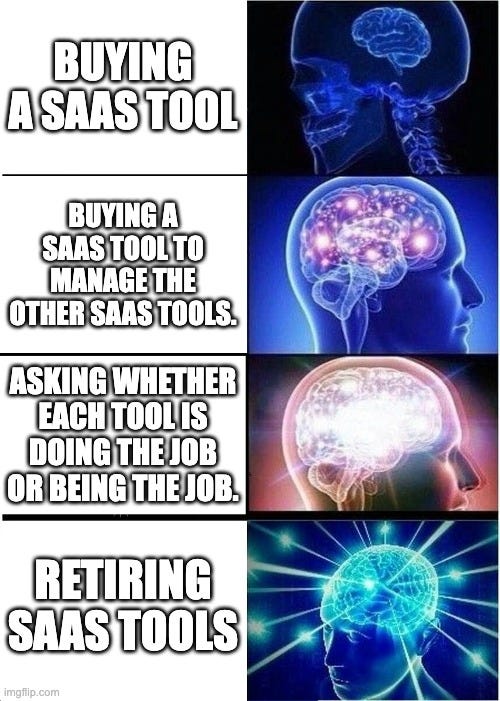
So what do you do with this? The instinct, and you will feel it, is to go buy another tool: the one that promises to consolidate. I’ve watched three founders do exactly this in the last year. All three added a tool. Zero removed a tool. Consolidation tools are a category, not a solution. If you add a consolidator without retiring the things it’s supposed to consolidate, you now have 10.4 apps, and the 0.4 is the one you’re paying an extra forty dollars a month to feel better about the other 9.4.
Here’s the actual exercise. It takes ninety minutes on a Friday afternoon, and it’s the highest-leverage ninety minutes of ops work you’ll do this quarter.
Open your billing page, or your OpEx spreadsheet, or whatever your accounts tool calls the recurring subscriptions. Write down every single SaaS line item with a monthly or annual charge. There will be more than you remember. The first-time median is about 60% more than the founder’s guess.
For each tool, write the name of the one person who actually uses it for the one thing it does. Not the theoretical user. Not the team that has an account. The person. If you can’t name the person, the tool is a candidate for removal. If two tools resolve to the same person for overlapping jobs, one of them is a candidate.
Circle the three tools that eat the most time. Not the most expensive. The most time. You know which ones they are. They are the ones your team complains about at standup. They are the ones you personally log into reflexively, twelve times a day, for reasons you couldn’t explain if asked. Those three are where the cognitive tax compounds.
Now the hard part. For each of those three, ask: is this tool doing a job, or is the tool the job? The distinction is the whole fight. A tool doing a job is invisible when it works; you use it, you move on. A tool that is the job is the thing you find yourself tending to. CRM entries no customer will ever see. Dashboards that exist so someone on Monday can say the dashboards look good. Standup threads whose only reader is the person who wrote them. These are not productivity. They are performances of productivity, and your team is the audience and the actor at the same time.
Most teams can retire two to four tools in a single afternoon once they ask the job-or-the-job question honestly. The savings are modest in dollars and significant in brain. The brain, if you haven’t been tracking, is the more valuable asset.

One thing to notice: the new agent tooling changes the math on stack consolidation in a way almost nobody has absorbed yet. Three of the apps you currently open twelve times a day are APIs that a well-prompted agent can read from and write to on your behalf, and the agent can live inside one interface you already spend most of your day in. The twelve context switches become zero. The thing on the other side of the switch doesn’t go away; it becomes silent infrastructure, which is where it was always supposed to live.
Stack consolidation is one of the fifteen or so commercial levers sitting dormant in most early-stage businesses. It is, notably, the one that gives your engineering team their afternoons back, and engineers-with-afternoons is a stronger growth lever than any of the tools you were paying to replace.
Put ninety minutes in the calendar for this Friday. Open the billing page. Count the tools. Then ask each one whether it’s doing the job or being the job. The answer will surprise you. The cut won’t.